

Marble base with dedication to “Gabinius Vettius Probianus” located at the entrance to the Basilica Iulia
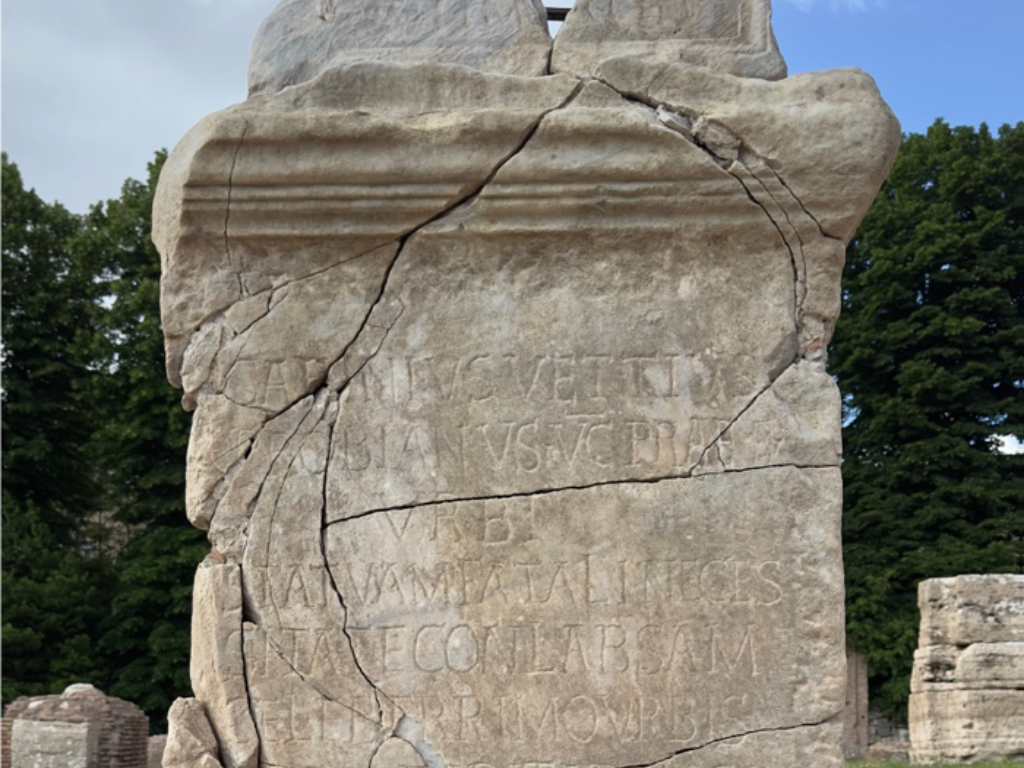
The restoration project of the statue marble base with dedication to Gabinius Vettius Probianus located on the right side of the entrance to the Basilica Julia, is part of the thesis work of Istituto Centrale per il Restauro student Yi Rong, which will take place in situ.
The work has been divided into two parts, restoration of the artifact and experimentation with methods for removing residual staining induced by biocide treatments on biological patinas.
-
Base for statue re-erected by Gabinius Vettius Probianus, prefect of the City. Rome, Forum. 377.
INSCRIPTION
In eight lines. Letter height 5.5-6 cm.
Gabinius Vettius / Probianus, v(ir) c(larissimus), praef(ectus) / urbi, / statuam fatali neces/sitate conlabsam, /(6) celeberrimo urbis / loco adhibita diligen/tia reparavit.
‘Gabinius Vettius Probianus, of clarissimus rank, prefect of the City, diligently restored [this] statue, fallen in a fatal calamity, brought to the most frequented location of the city.’
DESCRIPTION
White marble base, 140 x 93 x 77, the base was broken into pieces and reassembled with clamps and cement. All four sides are preserved.
The left side suggests that it was smoothly finished on all sides.
The epigraphic field measures 92 x 71 cm. It is rough, irregular and deep, indicating that itwas cut back for re-use.
The front of the base was framed by mouldings on all sides, but these were chiselled out at the timeof re-use. The right side was decorated with a patera.
The left side is badly damaged. It has three modern dowel holes, and maybe some pieces used in the reconstruction of the base are extraneous.
The top is largely covered by another base. It has a round dowerl hole carved for the removal of metal.PROVENANCE AND LOCATION
The base was found in the Roman Forum, in front ot Temple of Antoninus and Faustina; it is still in the Roman Forum, in front of the Basilica Iulia.
SUBJECT
The subject of the statue is not identified by the inscription.
We are told that it a statue that had been damaged by a ‘fatal calamity’ was restored and moved to a most frequented location.
Our Gabinius Vettius Probianus was almost certainly the Probianus prefect of the City in 377.
It has been suggested that he might have been the Probianus who was urban prefect in 416. However, it makes more sense to identify this later prefect with Rufius Probianus, vicarius urbis Romae in the early 5th century. -
Conservation status
The base, discovered and placed inside the Roman Forum towards the end of the 19th century, is now eroded and covered with a black patina of biological origin. The white cement plastering, now altered, most likely dates back to the previous restoration work carried out in the same period. These are typical characteristics of a work restored at the end of the 19th century and exposed for a long time to atmospheric agents and a polluted urban environment.
-
Restoration intervention
The restoration work was carried out in full compliance with the key principles formulated by Cesare Brandi, based on the criteria of minimal intervention, reversibility and recognisability. Given the outdoor location of the work, the choice of products used for the restoration was oriented towards materials that are fully compatible with the nature of the stone substrate and have adequate resistance to atmospheric agents. The restoration work involved gluing the stone fragments and consolidating the detached areas, with the aim of restoring cohesion and structural integrity to the artefact. After removing the old grouting, the restoration was carried out using hydraulic mortar, selected to ensure both mechanical continuity and aesthetic consistency with the original surface. The combination of interventions restored the structure’s stability and legibility, in full compliance with the methodological principles of conservative restoration.
The in-depth study focused on the removal of the black biological patina that had become deeply ingrained in the marble, a phenomenon typical of stone artefacts located outdoors. Microbiological analyses revealed a predominant colonisation by microorganisms called cyanobacteria, which also develop inside the stone and are resistant to solar radiation, even in extreme environments. The research initially evaluated the effectiveness of various biocidal treatments, both synthetic and natural, with the aim of verifying their ability to devitalise this specific form of biological colonisation and the resulting aesthetic effect of the treatment on the original colour of the stone artefact.
The most effective combination was that of two traditional products, which proved capable of significantly reducing operating times and guaranteeing satisfactory results in terms of both conservation and aesthetics. Finally, while recognising the effectiveness of this solution, it is nevertheless considered essential to continue research into the identification of alternative biocides of natural origin and innovative treatment procedures capable of ensuring high performance levels and greater compatibility with the health of operators and the environment.
The conservative restoration of the base of Gabinius Vettius Probianus and the study dedicated to the removal of the black biological patina have produced positive results for research and for the Parco archeologico del Colosseo, and represent a concrete contribution to the definition of more effective operational strategies as well as the dissemination and sharing of the culture of restoration.