

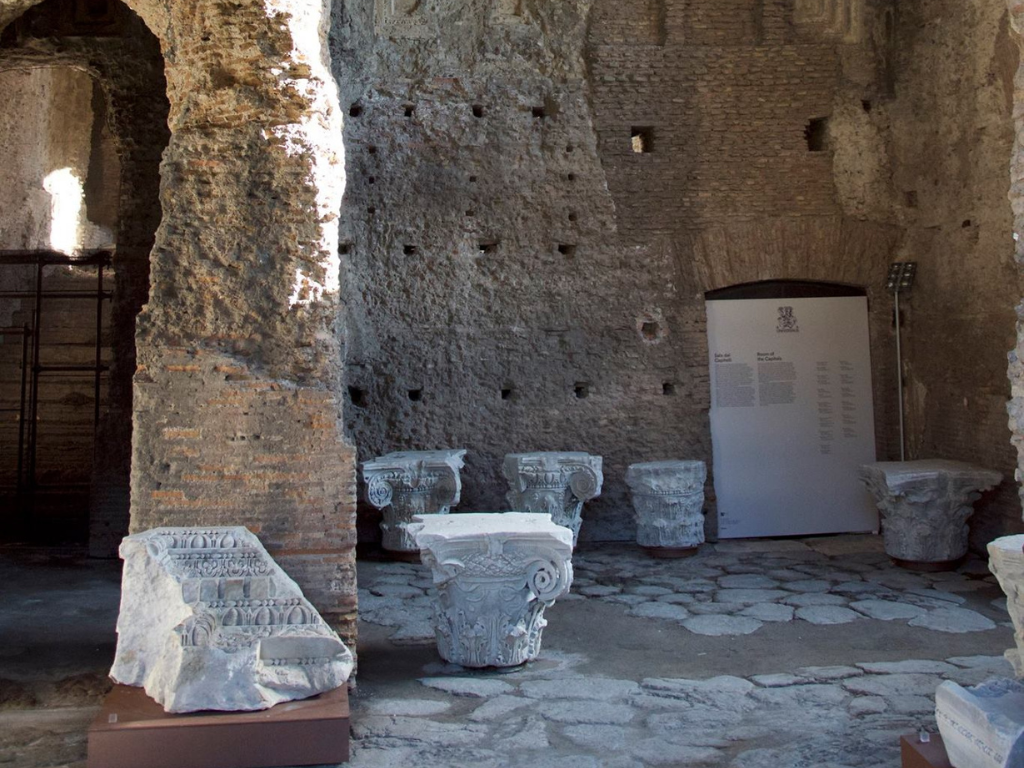
In the south-eastern corner of the Palatine Hill, near the Domitian Stadium, is the so-called Severian Complex, a six-level complex connected to the stadium’s exedra. This complex includes two rooms, little known but of great value, characterised by stucco vaults in the first and polychrome wall decorations in the second.
In September 2025, conservation work began on these rooms, preceded by a 3D laser scanner survey and the cataloguing of archaeological materials. The work is now focusing on the restoration of the decorated surfaces and flooring and will conclude with the improvement of the closures and protection of the rooms.
The restoration work, currently in progress, consists of consolidating the plaster, reattaching the paint layers, cleaning the decorated surfaces with laser technology, filling the cracks and balancing the colours of the surfaces where necessary. The room with painted walls still preserves fragments of the original black and white mosaic flooring.
The two rooms are distinguished by rather different conservation conditions: the vaulted room retains its original wall decoration, hidden beneath a thick layer of carbonate encrustation, characterised by a uniform yellow background against which geometric squares and red decorations applied dry stand out. The wall plaster shows extensive detachment in the lower-middle section of the walls. There is also plaster loss at the vault where it meets the next room, exposing the underlying preparation layer.
The plaster is bordered by a wide pozzolan mortar curb bearing fascinating 19th-century signatures. The conservation work on the walls involves the removal of surface encrustations, the restoration of adhesion between the different layers of plaster, and the mechanical removal of previous grouting. The surface is being cleaned using laser ablation to reduce the layer of carbonate concretions.
For surfaces that have lost their plaster and exposed the underlying cement, the removal of the coherent surface deposit is underway, as well as the restoration of the cohesion of the mortar and the textural elements of the wall surface, the grouting of the joints and the restoration of adhesion in the case of flaking of the wall fabric. The flooring will be treated by removing the thick layer of loose deposits and creating a floor screed at the level of the mosaic. The mosaic fragments will be cleaned, consolidated and grouted around the edges.
The hall of capitals retains its stucco decoration on the vaulted ceiling, while the walls of the room are divided into sections of brick curtain walling and sections where the curtain wall has fallen away, exposing the underlying cement. The flooring is made of paving stones laid in a post-antique phase and is sealed at the joints with a modern conglomerate.
The walls retain some small but precious fragments of stucco wall decoration that have never been touched. These fragments will be cleaned and treated with a biocide; the adhesion and cohesion will be restored, the edges and micro-cracks will be filled, and the colour will be balanced.