

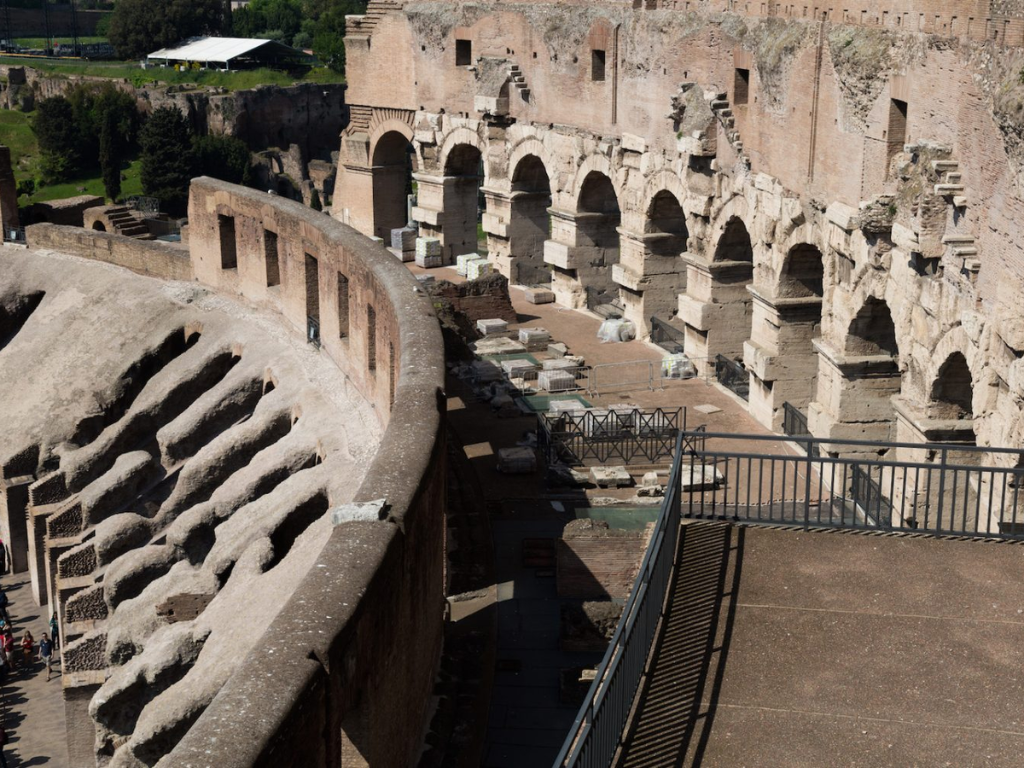
Beda the Venerable, a monk who lived in the 7th century prophesied that.
Quamdiu stat Colysaeum stat et Roma, quando cadet Colysaeum cadet et Roma, when cadet et Roma cadet et mundus,
As long as the Colosseum exists, Rome will also exist; when the Colosseum falls, Rome will also fall; when Rome falls, the world will also fall
And this is perhaps also why the Colosseum needs to be cared for and maintained with constancy and attention! the Colosseum is a large and fragile monument, set in a complex urban context and visited by millions of visitors every year (14 million in 2024 alone) for these reasons specific attention to its preservation is necessary.
-
Planned maintenance of the Colosseum
For the past few years a complete system of planned maintenance of the Colosseum, the Arch of Constantine and the Meta Sudans aimed at the preservation of the structures and decorative apparatuses, but also at the operation of its facilities, allowing the good preservation and the exciting and safe visit by visitors.
The maintenance of the Colosseum is conducted by a multidisciplinary team consisting of 5 restorers, 11 skilled workers, and 2 cleaners who work 365 days a year, 7 days a week from dawn to dusk for the preservation of surfaces and structures, supported by architects, archaeologists, cultural heritage diagnosticians, photographers, chemists, geologists, biologists, and structural engineers who actively collaborate in the well-being of the monument that never -quite- closes by working every day for:
– restoration and maintenance of surfaces and decorative features such as stuccoes, frescoes, artifacts
– maintenance of ancient structures in travertine, tuff, marble, brick, mortar
– widespread-museum maintenance
– archaeological excavations
– maintenance of structures with elevating platforms and rope work
– repair of damages and removal of graffiti vandalism
– facilities maintenance
– support of major events
– cleaning and decorum
– research, study and experimentation
Since 2024, the Colosseum has been equipped with a full 3D survey of the monument and an HBIM -Heritage Building Information Modeling- to support the management, maintenance, design of new interventions but also the promotion, knowledge and enjoyment of the asset.
The large number of visitors and the Parco concern for the environment has led to the search for sustainable maintenance and green methods to protect the monument, the environment, and the wildlife that inhabits it.
– we reduce water consumption
– we eliminate the use of harmful substances
– we regulate activities according to resident wildlife (cats, small raptors and birds, reptiles and rodents)
– we experiment with green and bio-based methods for consolidating materials and controlling biodeteriogens such as essential oils and plant extracts
Our challenge is to conduct maintenance and conservation activities while not limiting the enjoyment of the monument and the activity of study and in-depth study.
-
The Passage of Commodus
The underground gallery, known as the Passage of Commodus, was an underground path connecting the stage reserved for the empire’s high hierarchies (pulvinar) located at the southern end of the Colosseum’s minor axis, oriented north-south, and the exterior of the monument.
It owed its name of the Emperor Commodus (180-192 CE) derived from the far from certain correspondence to the gloomy location of the Amphitheater in which he, a lover and expert himself in gladiatorial combat, underwent an assassination attempt by a conspirator (Cassius Dione, LXXII, 4).
By the time of Commodus the imperial cryptoporticus existed. Not planned at the construction stage, it was built, according to the brick stamps found on the masonry, between the last years of Domitian’s reign (81-96 AD) and Trajan’s empire (98-117 AD), involving major changes to the structures and plumbing of the Amphitheater, not compromising its overall functioning.
The corridor consisted of three arms: two, diverging, of East-West direction, while the third, which constituted its connecting element, perfectly oriented North-South and provided with marble-covered skylights, arranged at regular intervals, useful to illuminate and ventilate the path. Leaving the Amphitheater, it bent in an easterly direction, toward a destination still unknown, but which could be either the area of the gymnasiums, including the Ludus Magnus, or the Caelian Hill.
Although its extent, function, and chronological attribution are still unspecified, its purpose is indicated by the luxurious stucco and marble coverings that originally adorned its vault and walls and also underwent modifications and restorations over the centuries until the end of the performances.
At an early stage, the vault was embellished with stucco, while marble slabs interspersed with pilasters (barely protruding pillars), with cornices and plinths at the base of the walls, drew wide panels on the walls.
Later, when the marble was removed, a white background pictorial decoration was made with plant or faunal elements and isolated figures. On the vault, however, a rich stucco ornamentation continued to exist, with panels and clypeus enclosing figured motifs inspired by the mythological and Dionysian spheres.
No trace is preserved of the original flooring, but a small portion of the later black-and-white mosaic, visible in the first branch.
The two perimeter niches originally belonging to the service gallery that ran around the arena floor but included in the cryptoporticus, show part of the preparatory drawings for a stucco decoration of scenes of amphitheater performances, dated back to the second half of the 2nd century.
The importance of the Passage of Commodus was emphasized already at the time of its discovery, in the years 1810-1814, carried out by the French government with architect Carlo Lucangeli. Excavated in 1874 by Pietro Rosa, it was again investigated in the 1890s.
This latest research is now being followed by restoration work aimed at recovering the structures and decorated surfaces of the passage. Over time, the weathered surfaces have been affected by the associated forms of degradation. As well as phenomena of decohesion and detachment of the stucco decorations. The surfaces are uniformly covered with a thick layer of dust deposition and pollution.
The decorated stucco surfaces located within the two niches of the southern wall and their preparatory layers will be treated by performing:
– biocide and herbicide treatment
– removal of incoherent deposits with water
– stuccoes laser cleaning
– reestablishment of cohesion and adhesion of grouts and pozzolanic preparation layers
– removal of unsuitable grouts
– grouting of cracks and fractures
Still appreciable along the portion of the passageway that preserves the original covering vault are some fragments of wall pictorial film that still retains traces of color, which are currently poorly legible due to the conservative conditions and the layer of biological deposits and patinas covering them. For these lacerates we plan to intervene with the removal of the incoherent surface deposit, by means of preconsolidation prior to all conservation activities, removal of partially coherent and coherent deposits by dry and with water and soft brushes, disinfection for the purpose of removing biodeteriogens present on the surface, inorganic salt packs, cleaning with laser instrumentation, mechanical finishing of the cleaning.